Why a Cycle-Driven SOXL Trading Strategy Beats Chasing Chip Earnings and Headlines
Updated: May 5
SOXL traders have a specific problem. They get bullish into NVIDIA earnings, buy the rip, and watch the gap fade. Then they swear off the trade for two weeks. Then a chip rumor hits, they buy again, and the same thing happens. The pattern is consistent enough to be embarrassing, and it has nothing to do with whether the trader's view on semiconductors is right or wrong.
The problem isn't analysis. It's timing. Semiconductors lead the market on the way up and on the way down, which means they show cycle behavior earlier and more violently than almost any other sector. A 3x leveraged semi ETF amplifies that violence, so getting the timing wrong on SOXL costs you twice. Once because you're in the wrong phase of the sector cycle, and again because the leverage compounds the mistake.
The fix isn't reading more analyst notes or guessing the next earnings call. It's putting a cycle framework underneath the trade, so the question becomes "is the structure favorable for a leveraged semi position right now" instead of "do I think chips are going up." Those are different questions. The first one has answers. The second one is a coin flip dressed up as a thesis.
This article walks through how cycles, crossover averages, and price channels turn SOXL from a headline lottery into a tradable instrument. Same tools Steve has used since 1990, applied specifically to the leveraged semi setup. The point isn't that you'll win every SOXL trade. The point is you'll stop losing the obvious ones.
Why SOXL Punishes Earnings-Driven Trading
Most SOXL losses come from a single mistake repeated in a hundred forms. The trader builds a thesis around a chip cycle headline, sizes up around an earnings date, and treats SOXL like a high-conviction directional bet. By the time the news arrives, institutions have already positioned for it. The reaction the trader expected has already been priced in, sometimes days earlier, and the post-earnings move is the unwind, not the kickoff.
Semiconductors are an institutional sector, which makes this worse. Chip companies are owned by funds that telegraph nothing, rebalance quietly, and move size before any retail-visible news. When SOXL gaps up the morning after good earnings, that's often the exit liquidity for the institutions who bought a week ago. The retail trader buying that gap is the counterpart for someone who already made their move on cycle timing. Leverage just amplifies the mistake.
The other piece is volatility decay. SOXL resets daily, so choppy semi action eats the position even when the directional thesis was right over a longer window. A trader who bought SOXL in early 2024 thinking the AI cycle would push semis higher might have been right on the macro and still lost money on the vehicle, because the path mattered more than the destination. The article on Volatility Decay and Why Leveraged ETFs Multiply Losses During Declines covers this dynamic in detail and explains why SOXL especially needs cycle timing rather than buy-and-hold conviction.
How Cycles Read Semiconductor Strength and Weakness
Semis tend to lead the broader market, which makes them a useful read on cycle position even if you're never going to trade SOXL. When semiconductors outperform on green days and hold up on red days, the broader cycle is healthy. When they fade on rallies and lead the selling on declines, the cycle has lost its tailwind. Reading this leadership pattern is the first piece of a SOXL strategy.
The intermediate cycle is the time-frame that matters most for SOXL trades. Day-trading SOXL is mostly a way to lose money to commissions and spreads, and holding SOXL for months runs into volatility decay. The four-to-six week intermediate cycle window is where the vehicle's leverage actually pays for itself, assuming the cycle is moving in the direction of the trade. Cycle bottoms in semis often arrive a week or two before broader market bottoms, which is one of the few timing edges the leveraged sector ETF actually offers.
Sector rotation matters too. Chips don't trade in isolation. When defensive sectors are leading and semis are lagging, the broader cycle is in a corrective phase and SOXL is the wrong vehicle. When semis start outperforming defensives on relative strength, that's an early read that the cycle is turning back up. The relationship between rotation and broader market structure is covered well in Market Correction vs Crash and How Rotation Keeps Bull Markets Alive, which explains why semi leadership often appears before headlines confirm a turn.
Want to see where the semiconductor cycle stands today and whether SOXL is in a favorable phase?
Members get the daily Forecast charts that show cycle positioning across all three timeframes, the crossover levels that confirm leveraged ETF entries, and the daily commentary that translates structure into actionable swing trades.
The Crossover Setup That Tells You SOXL Is Tradable
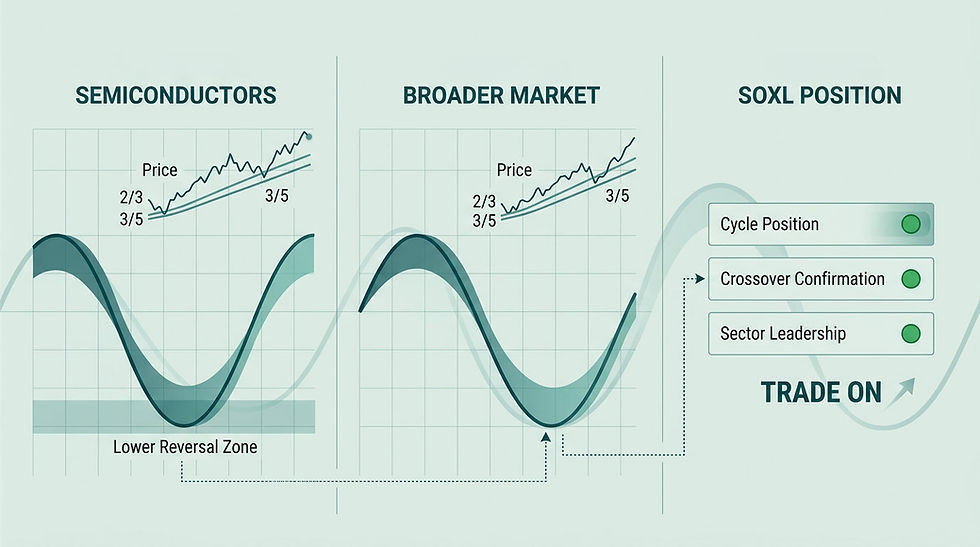
A SOXL trading strategy needs more than cycle direction. It needs confirmation that price is actually doing what the cycle suggests it should do. Crossover averages provide that confirmation. The 2/3 and 3/5 crossovers track short-term momentum on SOXL itself, and the 4/7 tracks the deeper trend. When SOXL reclaims the 2/3 and 3/5, holds above them, and follows through with another close near the highs, the entry is on. Until then, the cycle setup is just a setup, not a trade.
The same crossovers govern exits. A long SOXL position holds while price stays above the 2/3 and 3/5. The first warning is a close back below those averages. The exit is the next session that confirms the break, which is usually a lower high followed by a close beneath the crossovers. Stops sit just under the crossover that's currently holding, tight enough to limit damage when the structure breaks but wide enough to avoid getting shaken out by ordinary intraday noise.
The crossover system gets misunderstood a lot, which is why it deserves its own explanation. It's not a trend-following moving average like the 50-day or 200-day. It's a confirmation tool that tells you whether price has actually committed to the direction the cycle is suggesting. The piece on Moving Average Crossover Strategy and the Truth About Confirmation vs Prediction explains why this distinction matters and how using crossovers for prediction, which is what most traders do, leads to the whipsawed entries that kill SOXL accounts.
When to Step Out of SOXL Entirely
Sometimes the right SOXL trade is no SOXL trade. Choppy semi action with cycle indecision is one of the worst environments for any leveraged ETF, and SOXL specifically is sensitive to it because semiconductors swing harder than the broader market in both directions. A trader who tries to force SOXL trades through these periods gives back the gains earned during clean cycle phases and then some.
The signs of a stand-aside environment are usually visible. Cycles in mid-range, crossovers flipping back and forth across price, weak closes followed by strong opens followed by weak closes again. When the chart starts looking like a heart-rate monitor instead of a cycle wave, the structure is telling you to wait. There's no reward for trading through chop in a 3x leveraged vehicle. The decay alone will eat the position even if you happen to be right on direction over a longer window.
The harder discipline is stepping out when SOXL has just had a great run and the long-term cycle is starting to roll over. Traders who made money on the way up tend to overstay, convinced that the next dip is just another pullback. Sometimes it is, and sometimes it's the start of a corrective phase that turns the leverage against them. The framework says exit when the crossovers fail and the cycle structure breaks, not when the news still sounds bullish. Trusting the structure over the narrative is what separates traders who keep their gains from traders who give them back.
What People Also Ask About SOXL Trading Strategy
Is SOXL a good ETF for swing trading?
SOXL works for swing trading when the trader has a cycle framework underneath the position. Without one, the leverage and the volatility chew through accounts even on directionally correct trades. With cycle timing, SOXL's leverage actually helps because the same cycle that would produce a 5 percent move in the underlying semiconductor index produces a much larger move in SOXL, which makes the favorable trades more profitable when entries and exits are clean.
The catch is that SOXL is unforgiving when entries are early or exits are late. A trader who's right about the cycle direction but enters before crossover confirmation can sit through a decay drag that wipes out the eventual gain. Swing trading SOXL well means waiting for the entry signal even when you're sure the move is coming, then exiting on structural breaks even when the news still sounds positive. That's harder than it sounds.
When is the best time to buy SOXL?
The best time to buy SOXL is when the intermediate semiconductor cycle is turning up out of the lower reversal zone, the long-term cycle hasn't actively rolled over, and price has reclaimed the 2/3 and 3/5 crossover averages with follow-through. That's a specific setup, not a vibe. Each component has to be present, not just two out of three.
Buying SOXL because chips have been beaten down and the news sounds bad is a popular approach that mostly produces losses. Cheap can get cheaper, and oversold semiconductors can stay oversold for weeks longer than the trader's account can absorb. Waiting for cycle confirmation feels slower, but it's what keeps the trade aligned with what the structure is actually doing.
How do you avoid losses with SOXL?
The single biggest source of SOXL losses is trading without a cycle framework. Traders who don't know where the intermediate cycle stands are guessing, and 3x leverage on guesses is how accounts get cut in half. Adding cycle position as a filter, even a rough one, eliminates a huge percentage of the worst trades automatically.
The second biggest source is overstaying winners. SOXL gains feel different than regular ETF gains because the leverage produces dramatic moves in short windows. The temptation is to let it ride past the structural exit signal, which is exactly when the same leverage starts working against you. Pre-defining the exit before the entry, and actually executing it when the crossover breaks, is how you keep the gains the cycle gave you.
Should you hold SOXL long term?
Holding SOXL long term is mostly a bad idea because volatility decay erodes the position even when the underlying semiconductor index trends higher. SOXL is designed for short-duration trades that align with cycle moves, not for buy-and-hold investing. A trader who wants long-term semiconductor exposure is better off in SMH or SOXX, which track semis without the leverage decay drag.
The exception is during sustained, low-volatility uptrends in semis where the long-term cycle is rising and pullbacks are shallow. In those conditions, SOXL can outperform unleveraged exposure for weeks at a time. But those conditions don't last forever, and the trader who treats them as permanent will give back the gains during the next corrective phase. Cycle awareness is what tells you when to extend the hold and when to flatten the position.
What's the difference between trading SOXL and TQQQ?
SOXL gives you 3x semiconductor exposure; TQQQ gives you 3x Nasdaq-100 exposure. The difference matters because semiconductors lead the broader Nasdaq, especially during cycle turns. A SOXL trade often signals the right direction earlier than the equivalent TQQQ trade, but it also fades faster when the cycle rolls over. Semis amplify everything.
Most traders who use both end up rotating between them based on what the cycle is doing. Strong tech leadership with broad participation favors TQQQ because the move is more durable. Narrow semi-specific leadership in an otherwise mixed market favors SOXL because the chip cycle is doing the heavy lifting. The cycle position dictates which vehicle is appropriate at any given moment, not the trader's preference.

Resolution to the Problem
The SOXL problem isn't that the vehicle is broken. It's that most traders use it without the cycle framework that makes it tradable. They buy on earnings, on news, on conviction, and on hope. None of those work consistently with 3x leverage on a sector that swings as hard as semiconductors do. The losses aren't bad luck. They're the predictable result of using a precision instrument like a hammer.
Cycle timing turns SOXL into something else. The trade isn't "I think semis are going up" anymore. It's "the intermediate cycle is rising, the crossovers have confirmed, the broader market backdrop is constructive, and the structural exit is defined at the 2/3 break." That's a different trade with different odds. It still won't work every time, because no framework wins every trade. It works often enough that the wins outweigh the losses, which is the only standard that matters with leveraged positions.
Join Market Turning Points
The hardest part of SOXL trading isn't picking direction. It's knowing whether the cycle structure backs the trade you're about to make.
Most SOXL traders find this out the wrong way. They take the position, watch it move against them for two days, and only then start asking whether the setup was real. The cycle position was readable before the entry. The crossover signals were already telling a story. The trader just didn't have the framework to see what was there.
Inside Market Turning Points, members get the daily Forecast charts showing where the intermediate semi cycle stands, the crossover levels that confirm or deny SOXL entries, and the Visualizer projections that show when the next reversal is likely. Instead of guessing, you trade the structure. If you want to stop chasing chip earnings and start trading semis when the cycle actually favors the position, join us and follow the market with a structured process instead of guesswork.
Conclusion
A SOXL trading strategy that works has cycle timing as the foundation and crossovers as the confirmation layer. Without those pieces, SOXL is a high-volatility lottery ticket that occasionally pays off. With them, it's a vehicle for capturing semi cycle moves with leverage that actually compounds in your favor instead of against you.
Headlines will keep being loud. Chip earnings will keep producing dramatic gaps that look like opportunities. The trader who learns to read the cycle first stops getting fooled by the noise. The trader who doesn't keeps funding the brokers.
If you want to know whether the semi cycle currently favors a SOXL position, that's exactly what we track each day inside Market Turning Points.
Author, Steve Swanson


