What Is a Gap Up in Stocks, and How Cycle Position Decides If You Chase It
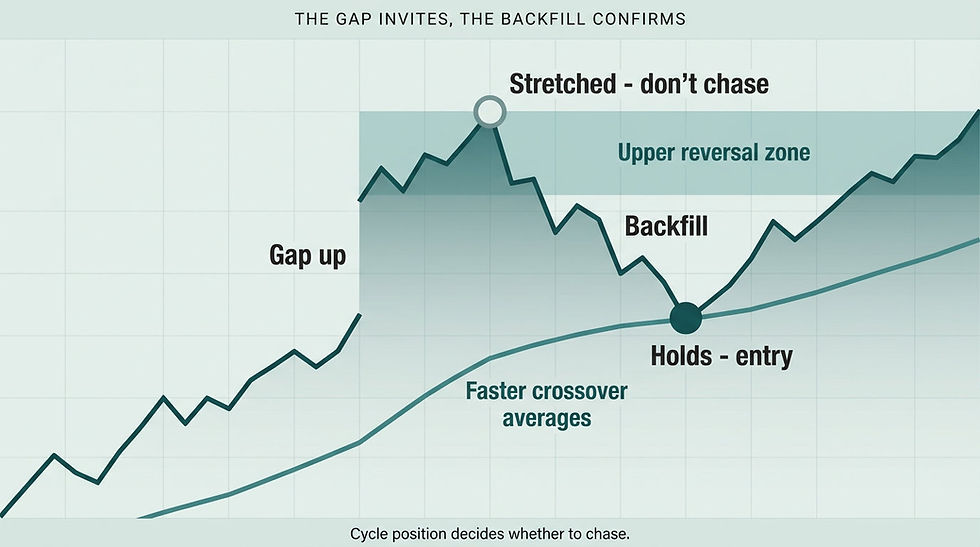
You check the market before the open and futures are sharply higher. By the time trading begins, prices have jumped well above yesterday's close, and the chart shows a visible space where no trading occurred. That space is a gap, and when it opens upward it creates one of the most uncomfortable decisions in trading: buy now at a price that already moved without you, or wait and risk watching it run further.
Ask what is a gap up in stocks and most answers stop at classifying them, sorting each one into a category and predicting what it means. That approach misses the question that actually determines your outcome. What matters is not what kind of gap it is but where the cycles stand at the moment it appears. The identical gap can be a reasonable entry or a poor one depending entirely on whether the faster cycles have room to run or are already stretched near the top of their range.
This article explains what a gap up is and how to decide whether to chase it, using the cycle work Steve has tracked since 1990. The central idea is that a gap tells you about enthusiasm, not about timing. Strong buying can be entirely real and the underlying advance can be well supported, and it can still be a mistake to buy at the opening print. Those two things are not in conflict, and separating them is what keeps you from turning a good trend into a bad trade.
The short version is this. When a large gap up occurs while momentum and the short-term cycles are already near their upper reversal zones, chasing the open means buying at the most stretched point of the fast cycle. The better approach is to let the market backfill some of that move, which is normal, and then watch whether the pullback holds above the faster crossover averages and the recently reclaimed channel levels. If it holds, the buying is real and adding makes sense. The gap is the invitation; the backfill is the confirmation.
What a Gap Up Actually Is
A gap up is a space on the chart where the price opens meaningfully higher than the previous session closed, with no trading occurring in between. It happens because the forces that set prices do not stop when the market closes. News arrives overnight, sentiment shifts, buyers accumulate orders, and by the time trading resumes the market has already repriced. The gap is simply the visible record of that repricing, the distance the market traveled while no one could transact.
What a gap up genuinely tells you is that demand appeared strongly enough to clear the previous session's prices before regular trading began. That is real information about enthusiasm. Buyers were willing to pay up rather than wait, which is not nothing. It reflects a market where the balance has tilted toward accumulation strongly enough that participants are competing to get positioned rather than waiting for better prices.
What a gap up does not tell you is anything about where you are in the cycle. It is a measure of urgency, not of position. A market can gap higher near the start of an advance, when the fast cycles have just turned up and plenty of room remains, or it can gap higher after a substantial rebound has already occurred, when those same cycles are approaching the top of their range. The gap looks identical in both cases. Everything that determines whether buying it is smart or costly comes from information the gap itself does not contain. For more on why waiting for the right entry is an active decision rather than sitting on your hands, see Trading Patience Is Calculated Positioning, Not Passive Waiting.
Why Cycle Position Decides Whether to Chase
The question of whether to buy a gap up comes down to where momentum and the short-term cycles sit when it happens. These are the fastest-moving cycles, and like all cycles they travel between a lower reversal zone, where declines tend to exhaust, and an upper reversal zone, where advances tend to exhaust. When a gap occurs with those fast cycles rising out of the lower area, the move has room ahead of it and buying into strength is reasonable. When it occurs with those cycles already pressing into their upper reversal zones, the fast move is largely complete even if the larger trend is healthy.
That distinction is what makes chasing a large opening gap a timing error rather than a directional one. The trend can be genuinely improving, with intermediate cycles turning higher and real institutional participation supporting the advance, and it can still be a poor moment to pay the opening price. Buying at the top of a stretched fast cycle means accepting the worst entry available within a move you were right about, which is a frustrating way to be correct. The mistake is not believing in the advance; it is ignoring where the fast cycles stand when you act on that belief.
This is also why the same gap deserves opposite responses at different points. Early in a recovery, with the fast cycles fresh and the intermediate cycles just beginning to turn, a gap higher is often the market telling you the move has begun and there is more to come. Later, after a strong rebound has already carried momentum into its upper zone, an equally impressive gap is more likely to be followed by consolidation than immediate continuation. Reading cycle position rather than gap size is what tells you which situation you are in. For more on why patience tends to pay once cycles have already run toward their peaks, see Market Consolidation Into July: Patience Pays After Cycle Peaks.
Want to see whether the fast cycles have room to run or are already stretched?
Members get the daily Forecast charts showing where momentum and the short-term cycles stand relative to their reversal zones, the crossover and channel levels that confirm a pullback is holding, and the daily commentary that separates gaps worth buying from gaps worth waiting out.
Backfilling Is Normal, and It Is Your Entry
When a market gaps up sharply and then pulls back part of that move during the session or over the following days, that pullback is called backfilling. It is a completely ordinary behavior and not a sign that the advance has failed. Some of the opening move typically comes from urgency, traders unwilling to wait, and once that urgency is satisfied prices often ease back toward a level where more patient buyers are willing to transact. Expecting some backfill after a large gap is realistic rather than pessimistic.
For a trader who declined to chase the opening print, backfilling is the opportunity. Instead of buying at the most stretched point of the fast cycle, you get to buy after some of that stretch has worked off, at a better price and with more information than you had at the open. The trade-off is that you accept the possibility the pullback never comes and the move continues without you. That happens sometimes. But over many decisions, buying stretched opens costs more than the occasional missed entry, particularly when the fast cycles were already near their upper zones.
The practical approach is to add into the backfill rather than into the gap. Position sizing helps here: taking an initial position and adding on the pullback captures participation without committing everything at the worst available price. That way a continued advance still works for you, and a normal backfill becomes a chance to improve your average rather than a source of regret. The goal is not to time the exact low of the pullback but to avoid paying the exact high of the opening enthusiasm. For more on holding your conviction in a bullish trend while expecting short-term weakness along the way, see Market Cycles Confirm Staying With Bullish Trends Despite Imminent Short-Term Pullbacks.
The Test That Confirms the Gap Was Real
Backfilling gives you more than a better price. It gives you a test, because where the pullback stops tells you whether the buying behind the gap was durable or superficial. The specific thing to watch is whether the backfill holds above the faster crossover averages, the 2/3 and the 3/5, and above any Donchian channel levels the advance recently reclaimed, typically the 5-day and then the 10-day. Those are the levels that were won during the move up, and defending them is what distinguishes a healthy pause from the beginning of a reversal.
When the pullback holds above those levels, it confirms that buyers are still present and willing to support prices rather than simply having satisfied a burst of urgency. Holding the 2/3 and 3/5 is the first requirement, and an advance that also keeps its 4/7 average and stays in the upper half of the 10-day channel is showing sustained demand rather than a single burst. That is the signature of real participation behind the move, and it means the advance has a foundation under it. In that situation, adding on the dips is the reasonable approach, because each pullback is being met by buyers rather than by an absence of them.
When the backfill fails, slipping back below the 2/3 and 3/5 and giving up the 5-day channel the advance had just reclaimed, the picture is different. The gap represented a burst of buying that exhausted itself, and there is nobody underneath to defend the new prices. That does not necessarily mean the larger trend has broken, but it does mean the specific move was not yet supported, and adding into it would have been premature. Either way you learn something concrete, which is more than the gap itself could tell you at the open.
What People Also Ask About Gap Ups in Stocks
What is a gap up in stocks?
A gap up is when a stock or index opens meaningfully higher than the previous session's close, leaving a visible space on the chart where no trading took place. It occurs because pricing forces continue operating while the market is closed: news arrives, sentiment shifts, and orders accumulate, so when trading resumes the market has already repriced higher. The gap is the visible record of that overnight move.
Practically, a gap up signals that demand was strong enough to clear the prior session's prices before regular trading began, with buyers competing to get positioned rather than waiting for better levels. That is genuine information about enthusiasm. What it does not indicate is whether the move has further to run, since a gap can occur early in an advance with plenty of room ahead or late in one when the faster cycles are already stretched.
Should you buy a stock that gaps up?
It depends entirely on where the fast cycles sit when the gap occurs, not on the size of the gap. If momentum and the short-term cycles are rising out of their lower reversal zones, the move likely has room and buying into it is reasonable. If those cycles are already pressing into their upper reversal zones, buying the opening print means paying the most stretched price available within the move, even when the underlying trend is genuinely healthy.
The more reliable approach in that second situation is to wait for backfilling, the normal pullback that follows a sharp opening move, and buy into that instead. You accept the occasional missed entry when the pullback never comes, but you avoid systematically buying at the worst price during stretched conditions. Over many decisions that trade-off favors patience, particularly after a strong rebound has already occurred.
Do gaps always get filled?
Not always, and treating gap filling as a rule leads to bad decisions in both directions. Many gaps see prices return to the pre-gap level, sometimes quickly, which is why the idea is so widespread. But plenty of gaps in strong advances are never filled, because the move that created them marked a genuine repricing that the market simply carried forward.
The more useful question is not whether a gap will be filled but whether the pullback that follows it holds above the levels that matter. Partial backfilling is normal and healthy. What distinguishes a constructive pause from a failed move is whether prices stay above the faster crossover averages and the channel levels the advance recently reclaimed, not whether the gap closes completely. Waiting for a full fill can mean waiting forever in a strong trend.
What is backfilling after a gap?
Backfilling is the pullback that commonly follows a sharp gap up, where prices give back part of the opening move over the session or the days after. It happens because a portion of the gap comes from urgency, traders unwilling to wait for better prices, and once that urgency is satisfied prices tend to ease toward levels where more patient buyers will transact. It is ordinary market behavior, not evidence the advance has failed.
For a trader who declined to chase the open, backfilling is the entry. It offers a better price than the gap and more information, since where the pullback stops reveals whether real buyers are present. Adding into the backfill rather than into the gap is the practical way to participate in a move without paying the most stretched price the move produced.
How do you know if a gap up is worth trading?
The test comes after the gap, not at the open. Watch where the market goes once the initial enthusiasm settles and some backfilling occurs. If prices hold above the 2/3 and 3/5 crossover averages and above the Donchian channel levels the advance recently reclaimed, the 5-day first and then the 10-day, buyers are defending the new territory, which indicates real participation supporting the move rather than a single wave of urgency.
If the pullback slices back below those levels and gives up what the advance had reclaimed, the gap was a burst of buying that exhausted itself without support underneath. That does not automatically mean the larger trend is broken, but it does mean the specific move lacked backing and buying it would have been early. Either outcome gives you concrete information that the gap alone could not provide.

Resolution to the Problem
The difficulty with a gap up is that it forces a decision at the worst possible moment for making one. Prices have already moved, the enthusiasm is visible, and the pressure to act before the market runs further is immediate. Investors who respond to that pressure buy at the opening print, and when the fast cycles were already stretched they end up with the worst entry available inside a move they correctly identified.
The resolution is to answer what is a gap up in stocks by separating the two questions the gap conflates. Is the advance real? That is answered by the intermediate cycles turning higher and by broad participation supporting the move. Is this the moment to buy? That is answered by where momentum and the short-term cycles sit relative to their upper reversal zones. When the answer to the first is yes and the second is no, the correct action is not to abandon the trade but to wait for the backfill and buy into it, checking that the pullback holds above the faster crossovers and reclaimed channel levels. The gap creates the urgency. Cycle position decides whether to act on it.
Join Market Turning Points
The hardest moment in a strong market isn't the decline. It's the morning the market gaps higher without you and you have to decide, in the first few minutes, whether to pay up or stand aside.
Most traders handle this badly because the gap gives them only half the information they need. They can see that buying was strong, but they cannot see whether the fast cycles have room left or are already at the top of their range, and those two situations call for opposite responses to an identical-looking open. So they chase, get filled at the high of the enthusiasm, and then watch a perfectly normal backfill turn a good idea into an uncomfortable position.
Inside Market Turning Points, members get the daily Forecast charts showing exactly where momentum and the short-term cycles stand relative to their reversal zones, the crossover and channel levels that reveal whether a pullback is being defended, and the daily commentary that says plainly when a gap is worth buying and when it is worth waiting out. Instead of guessing at the open, you know whether the fast cycles have room. If you want to trade gaps on cycle position instead of urgency, join us and follow the market with a structured process instead of guesswork.
Conclusion
A gap up is the space left when a market opens well above the previous close, and it tells you that demand was strong enough that buyers would not wait. That is real information, but it is information about urgency rather than about timing. The same gap means different things depending on where the fast cycles stand, and nothing in the gap itself reveals that.
The decision therefore belongs to cycle position. With momentum and the short-term cycles rising out of their lower zones, a gap higher suggests a move with room ahead of it. With those cycles already near their upper reversal zones, chasing the open means buying the most stretched price in a move that may be perfectly healthy underneath. In that case the better path is to let normal backfilling occur and then apply the test: does the pullback hold above the faster crossover averages and the channel levels the advance just reclaimed? If it does, buyers are defending and adding on dips makes sense. If it does not, the move lacked support and patience saved you money. The gap opens the question. The backfill answers it.
If you want to know whether today's strength has room to run or is already stretched near its upper reversal zones, that's exactly what we track each day inside Market Turning Points.
Author, Steve Swanson


